Sightseeing & tourist mobility
Tourist rail systems
Alignment and operation, considered together.
Discuss your project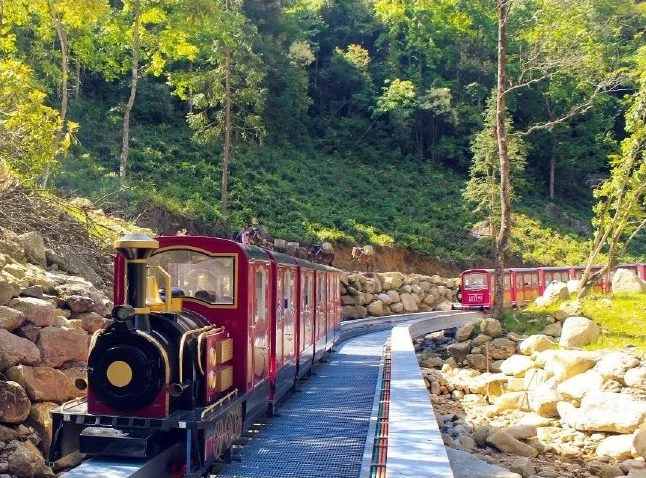
Engineering perspective
Alignment and operation, considered together.
Monorail, twin-rail and rack systems connecting destinations and creating scenic journeys, selected around terrain, demand and operations.
Selection begins with terrain profile, route length, curves and stations. An isolated maximum grade does not determine system suitability.
Train capacity and hourly throughput are different quantities. Frequency, track occupancy, stops and fleet size need joint assessment.
Track, power, controls, platforms and maintenance are project interfaces. Review stopping conditions and evacuation arrangements as part of the project.
| Families | Monorail, twin-rail and rack railway |
|---|---|
| Twin-rail gauges | 762, 1000 and 1435 mm series |
| Speed and grade | According to model, configuration and verified alignment |
Tourist trains: routes and operation
Scenic experience, boarding, routes and system operation.
System options and selection criteria
Swipe the table to view all criteria →
| Configuration | Application | Engineering criterion |
|---|---|---|
| Scenic monorail | Sightseeing routes and landscape integration | Check clearance envelope, supports, maintenance access and evacuation strategy. |
| Twin-rail tourist railway | Internal transport and scenic journeys | Track gauge alone does not determine capacity, speed or vehicle compatibility. |
| Rack railway system | Routes with demanding gradients | Assess traction, braking, curves, adhesion and recovery together. |
Inputs that define your project
- Alignment plan and longitudinal profile
- Peak directional demand
- Stations and operating mode
- Climate, access and utilities
Interfaces to resolve
- Track, supports and stations
- Power and controls
- Maintenance access and evacuation
Project documentation
- Agreed design inputs and criteria
- Drawings and interface schedule
- Fabrication and inspection documents
- Installation, testing and handover plan
Availability, detail and responsibilities are defined in the technical agreement.
Engineering questions
Is train load the same as passengers per hour?
No. A first estimate is Q = P × 60 / h × η, where P is passengers per departure, h is headway in minutes and η is occupancy. Cycle time, passing arrangements and boarding must support that headway.
Is a 30% gradient the same as 30 degrees?
No. Percentage grade is 100 × rise / horizontal run. A 30% grade is about 16.7°. The allowable limit depends on the confirmed system and alignment.
Further perspectives
Train capacity is not line capacity.
The next step starts with your requirements.
Location, intended use, site conditions and scope. The right inputs make a focused technical discussion possible.